
How do you manage crew and equipment heat loads in stationary military vehicles?
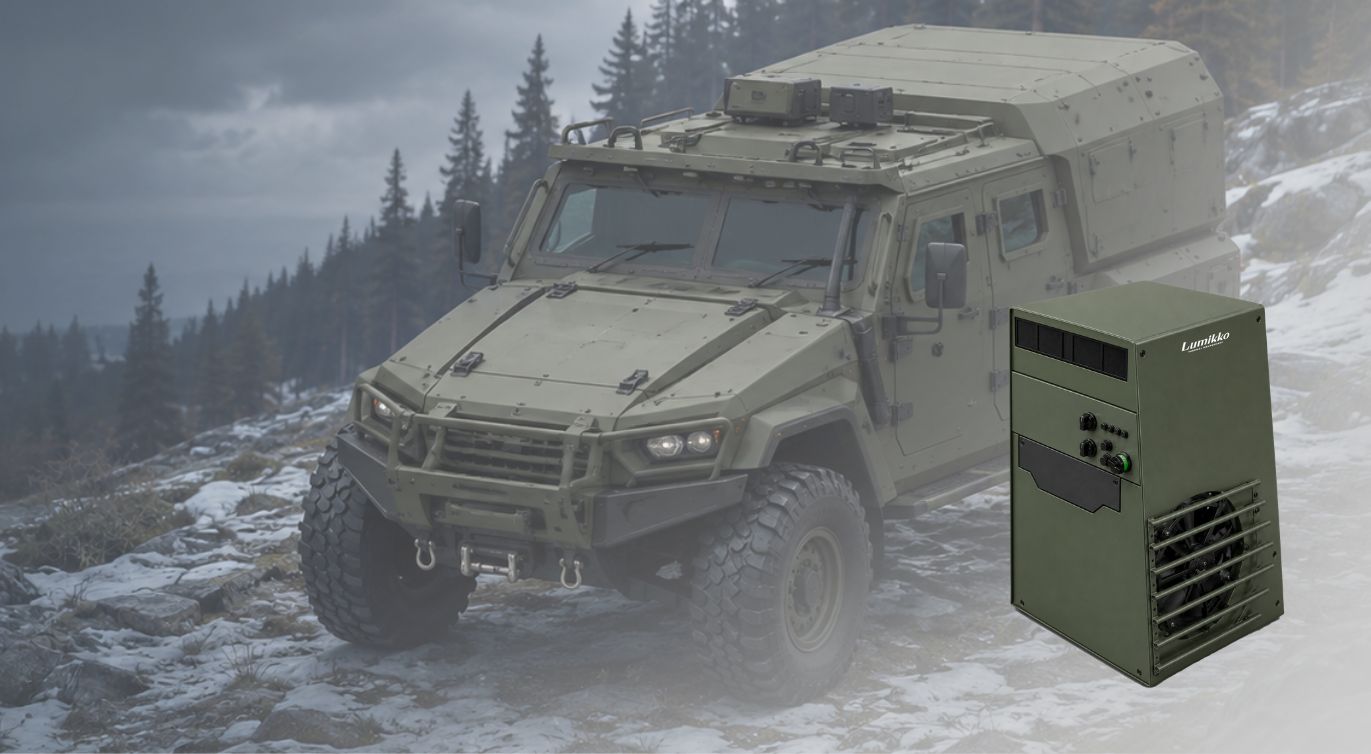
Managing crew and equipment heat loads in stationary military vehicles requires sufficient cooling capacity and a suitable power source for the intended operating mode. A vehicle can remain stationary while its main engine and HVAC system continue running. Where engine-off operation is required, cooling may be provided by electrically driven HVAC or an auxiliary system powered independently of the main engine.
Why can interior temperatures rise during stationary or engine-off operation?
Interior temperatures rise when heat gains exceed the heat removed from the crew compartment. Stopping the vehicle does not automatically increase the heat load or stop the air conditioning. However, switching off the main engine can stop an engine-driven compressor unless an alternative cooling arrangement is available. Heat from personnel, operating electronics, solar exposure, and surrounding structures may continue entering the compartment.
Vehicle movement also affects airflow over the exterior and heat exchangers. At a standstill, cooling performance depends on the system’s fans, installation, and operating conditions rather than vehicle speed alone. The system must therefore be assessed for stationary operation, including its ability to reject heat without relying on airflow generated by forward movement.
This is particularly relevant for command, communications, and sensor vehicles, where crew and equipment may remain active inside the vehicle for extended periods while the main engine is switched off.
What are the main sources of heat inside a stationary armored vehicle?
The main sources of heat inside a stationary armored vehicle are the crew, onboard electronic systems, and solar or ambient heat conducted through the vehicle structure. Each source contributes independently, and their combined effect can create significant thermal loads that must be managed by the cooling system available in the selected operating mode.
Personnel generate metabolic heat continuously, and in enclosed, insulated vehicle compartments this heat accumulates quickly. Electronic equipment, including communication systems, computers, control systems, and sensors, generates heat during normal operation. In modern armored vehicles, the density of onboard electronics has increased considerably, making equipment heat load a growing factor in overall thermal management planning.
The vehicle structure itself can also conduct and radiate heat into the interior. Armored hulls absorb solar radiation and ambient heat, and without active cooling this energy transfers into the crew compartment. In hot climates or during summer operations, this structural heat gain adds meaningfully to the internal thermal load, compounding the heat produced by crew and equipment.
How does crew heat load affect mission readiness and performance?
Elevated interior temperatures in military vehicles reduce crew alertness, increase the risk of heat stress, and degrade the performance of temperature-sensitive electronic equipment. When crew members operate in high-heat environments for extended periods without adequate cooling, both physical and cognitive performance can deteriorate, which directly affects mission effectiveness.
For personnel, sustained exposure to high interior temperatures increases physiological strain. Decision-making, reaction time, and situational awareness can all be affected. In tactical situations where the vehicle must remain stationary, for example during surveillance, command coordination, or waiting in a staging area, crew members cannot simply exit the vehicle to cool down. Interior thermal conditions therefore have a direct bearing on how long personnel can remain effective inside the vehicle.
Electronic systems also respond to heat. Communication equipment, navigation systems, and computing hardware typically have defined operating temperature ranges. When interior temperatures rise beyond those ranges, equipment reliability may decrease and the risk of malfunction increases. Managing crew and equipment heat loads is therefore not only a personnel welfare issue but a functional requirement for maintaining operational capability during stationary phases.
What cooling approaches are used to manage heat in stationary military vehicles?
Cooling during stationary or engine-off operation can be provided by the vehicle’s electrically driven HVAC system, a dedicated parking cooler, or another auxiliary cooling arrangement. Depending on the system architecture and available infrastructure, power may come from batteries, an auxiliary power unit (APU), or an external electrical connection.
Battery-powered parking air conditioning provides cooling without running the main engine. Its operating duration depends on usable battery energy, the cooling system’s electrical demand, other on-board loads, and the minimum battery reserve required by the vehicle. Cooling output and power consumption should be assessed together for the intended operating conditions.
Passive measures such as shading, suitable surface treatments, and insulation can reduce environmental heat gains. Ventilation can remove heat when outdoor conditions are suitable, while interior air recirculation mainly distributes air and can improve comfort. Recirculation alone does not remove the compartment’s accumulated heat or replace the required fresh-air supply.
A suitably integrated parking or auxiliary cooling unit may also supplement the main HVAC system while driving. This is a separate operating mode from engine-off cooling, and its use depends on the vehicle’s electrical capacity, controls, and cooling requirements.
How are HVAC and thermal management systems designed for military vehicle requirements?
HVAC and thermal management systems for military vehicles are selected, adapted, or designed according to the platform’s operating environment and project requirements. The solution may use standard products, modified modules, or fully customized designs, provided that the required performance and compatibility are verified. Key parameters include the electrical architecture, installation space, thermal loads, environmental conditions, and applicable customer or military requirements.
Military vehicles impose requirements that differ substantially from commercial applications. Vibration tolerance, ingress protection, electromagnetic compatibility, and reliability under extreme temperatures are among the factors that influence component selection and system architecture. Systems must also integrate with the vehicle’s existing electrical and control infrastructure, which varies between platforms.
Operating voltage is a fundamental design parameter. Many military vehicles operate on 24 VDC or 28 VDC electrical systems, and cooling units must be engineered accordingly. Cooling capacity is sized to the actual thermal load of the specific vehicle, accounting for the number of crew, the heat output of installed electronics, and the expected ambient conditions. A system designed for a light tactical 4×4 vehicle will differ substantially from one intended for a larger command or communications vehicle.
Installation location, whether on the roof, at the rear of the vehicle, or integrated into the superstructure, is selected based on airflow requirements, protection from the environment, and serviceability. Controls are configured to match the vehicle’s architecture, allowing the crew to manage cooling output according to conditions and operational priorities.
Lumikko has been developing HVAC and thermal management solutions for defense applications since 1985. Lumikko’s parking and auxiliary air conditioning solution for military and special-purpose vehicles is designed around exactly these requirements: battery-powered cooling with the engine off, selectable operating points to balance cooling performance against battery runtime, and flexible integration into different vehicle platforms. Cooling capacity, controls, ducting, and the electrical interface are configured according to the specific vehicle and application.
Would you like more information about our solutions? Reach out to us, and let’s create the right solution together. Cooling requirements for stationary military vehicles depend on the platform, the electrical system, the internal heat load, and the mission profile. Lumikko can help you assess those requirements, select the appropriate system, and integrate it into your vehicle. Contact our team to discuss your vehicle’s cooling requirements and request an offer.