
Container cooling options for defence applications compared practically
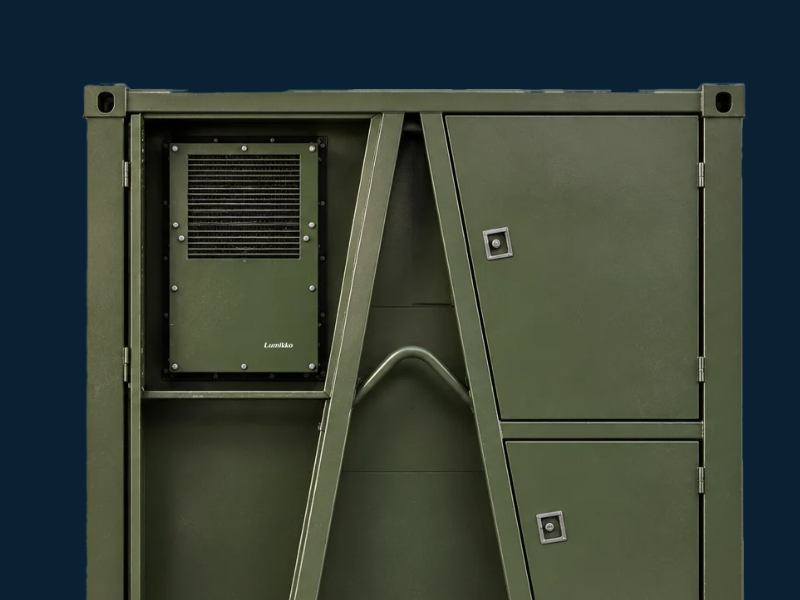
Defence containers and shelters operate in some of the most unforgiving environments imaginable: from Arctic forward operating bases to desert logistics hubs, from mobile command posts to fixed equipment rooms in active conflict zones. Maintaining reliable temperature control inside these enclosures is not a comfort consideration – it is an operational necessity. Sensitive electronics, communications equipment, medical supplies, and personnel may all require defined internal temperature conditions. Selecting the right defence container cooling approach requires a clear understanding of the available technologies, project requirements, and the specific deployment context.
This article compares several cooling approaches that may be used for defence applications, covering the key technical and operational trade-offs that procurement specialists and systems engineers need to weigh before specifying a solution.
Unique cooling demands of defence containers
Defence containers can present demanding thermal management requirements compared with conventional enclosures. The heat loads may be highly concentrated – for example, racks of communications and computing equipment can generate significant localised heat – while the ambient outside temperature may simultaneously be at an extreme. Depending on the application and protection concept, ventilation or outside-air exchange may also be restricted.
Beyond heat load, the operating environment introduces additional stressors. Dust ingress, humidity, salt exposure and other environmental conditions may need to be considered depending on the deployment environment. At the same time, the cooling system itself must be robust enough to withstand the transport, handling, vibration and environmental conditions defined for the application. Reliability requirements can be particularly demanding where cooling is critical to personnel or equipment operation.
Main container cooling technologies and their trade-offs
Several cooling technologies can be considered for shelter and container applications, each with distinct performance characteristics and limitations.
Direct expansion (DX) vapour compression systems are a widely used option for active container cooling. They can deliver high cooling capacity relative to size, operate without an external chilled-water supply, and can be engineered for a wide temperature range. The trade-off is mechanical complexity and the need to manage a refrigerant circuit appropriately throughout installation, operation and servicing.
Thermoelectric (Peltier) coolers offer a solid-state alternative at the cooling element itself and can be suitable for relatively small thermal loads and enclosures. However, their efficiency and available cooling capacity can make them less suitable for higher-capacity container cooling applications.
Liquid cooling loops can be relevant where specific equipment, such as high-density electronics, requires direct or dedicated thermal management. A liquid circuit can transfer heat from the equipment to another heat-rejection system. The suitability and architecture of such a solution depend on the equipment and container design.
Free cooling or other methods that use favourable ambient conditions may reduce mechanical cooling demand in suitable applications. Their feasibility depends strongly on outside-air conditions, required internal conditions, filtration and protection requirements, and the container’s operating concept.
With over 50 years of experience in refrigeration technology, Lumikko offers proven products, adaptable product platforms, and tailored solutions for demanding conditions. Find your right solution and discover how Lumikko’s range can be matched to different defence container cooling requirements.
How environmental ratings and standards shape the choice
Applicable standards and environmental requirements are important design inputs in defence procurement and should be defined according to the specific program and deployment environment. IP ratings, MIL-STD specifications, NATO STANAG requirements, or customer-specific specifications may apply depending on the system and project.
The required ingress-protection rating must be defined according to the actual exposure to dust and water; there is no universal IP54 minimum for all mobile defence container cooling systems. MIL-STD-810 provides environmental engineering and test methods covering conditions such as vibration, shock, humidity and temperature. The applicable methods, levels and test profiles must be tailored to the expected service environment rather than applied as a single standard test package. Where CBRN threats are part of the protection requirements, the HVAC system may need to be coordinated with a collective protection and filtration architecture. In an overpressure-based system, filtered air and controlled pressure can help reduce the ingress of untreated outside air.
These requirements influence system selection and verification and should be considered early in the design process.
Mobile versus fixed deployment: what changes in the cooling design
The distinction between mobile and fixed deployment is one of the most consequential factors in military container cooling system design. A fixed equipment room in a permanent facility may allow connection to building infrastructure and provide different space and maintenance constraints. A transportable or mobile tactical container may instead require a more self-contained solution compatible with the available field power supply.
For mobile applications, space constraints are critical. The cooling unit must fit within the container’s allocated footprint without compromising internal usable volume. Weight distribution and the transport loads and orientations specified for the container and cooling equipment must also be considered. The electrical design must be compatible with the characteristics and quality of the available power supply, including generator-fed operation where applicable. Fixed deployments, by contrast, may provide more flexibility in system size, infrastructure connections and maintenance access.
Some applications may also require the cooling solution to support more than one operational configuration, such as transportable and stationary use. The required operating modes should be defined according to the actual deployment concept.
Key selection criteria when specifying a defence container cooling system
When moving from concept to specification, a structured set of selection criteria helps ensure the chosen system meets both current requirements and long-term operational needs.
- Operating temperature range: Define both the ambient extremes and the required internal setpoint, including worst-case simultaneous conditions.
- Heat load characterisation: Identify peak and sustained internal heat loads from all equipment, including future upgrade allowances.
- Standards compliance: Identify the applicable environmental, EMC, ingress-protection, military and customer-specific requirements before evaluating technologies.
- Power supply constraints: Specify available voltage, frequency, and power budget, including generator-fed scenarios.
- Space and weight envelope: Define hard limits for the cooling unit’s physical dimensions and mass.
- Maintenance and logistics: Consider how the system will be serviced according to the intended maintenance concept, including spare-parts availability, service access and required skills.
- Lifecycle and reliability requirements: Define any applicable reliability, availability, maintenance-interval or lifecycle-support targets for the intended deployment.
Lumikko’s container cooling systems for defence applications include ready-to-use products and solutions that can be adapted to customer-specific structural, electrical and operational requirements. With over 50 years of experience designing thermal management systems for demanding and mobile conditions, Lumikko designs and manufactures its solutions in Finland. Project-specific verification and testing requirements are defined according to the application and customer requirements. We are recognised for our ability to flexibly customise our solutions to support integration with the customer’s application. This approach also enables the modernisation of existing equipment.
Would you like more information about our solutions or want to discuss your specific requirements with our experts? Contact us and let’s create the right solution together. You can also explore our full range of products and solutions to find the configuration that best fits your operational needs.