
How does a 5 kW military container cooling unit work?
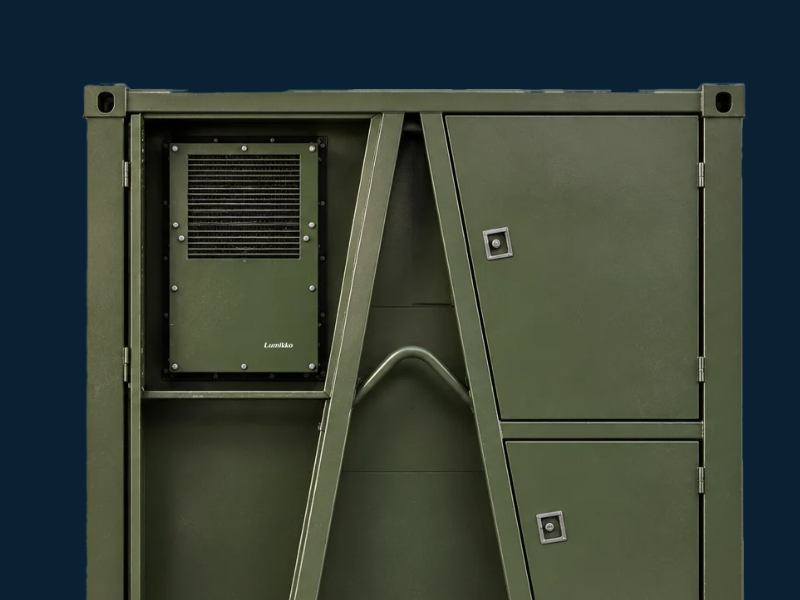
A military container cooling unit works by using a vapour-compression refrigeration cycle to remove heat from the interior of a defence container and reject it outside, maintaining stable temperatures for personnel, electronics, and mission-critical equipment. The 5 kW figure describes the unit’s cooling capacity, not its electrical input power. Whether this capacity is sufficient depends on the container’s cooling load and the unit’s performance under the specified operating conditions. The sections below unpack how these systems are engineered, what they contain, and why design choices in military applications differ from conventional cooling.
What makes container cooling different in military environments?
Military container cooling must be specified for the operating, transport, and storage conditions of the particular application. Requirements may include temperature extremes, vibration and shock, dust and moisture exposure, power-supply characteristics, and the consequences of losing cooling.
Depending on the deployment requirements, the system may need additional measures for mechanical durability, environmental protection, and integration into the container structure. The required performance and verification criteria should be defined for each project, taking account of the equipment and personnel the system is intended to support.
Space is another critical constraint. Defence containers are densely packed with electronics, communications equipment, and operational systems. A military container cooling unit must deliver effective temperature control while occupying as little of the container’s interior volume as possible. Installation geometry, air distribution, and the positioning of both the outdoor unit and the evaporator all need to be resolved within the specific constraints of the container structure.
How does a 5 kW military container cooling unit actually work?
A 5 kW military container cooling unit uses a vapour-compression refrigeration cycle. In the evaporator, refrigerant absorbs heat from the container’s interior air and evaporates. The compressor raises the refrigerant vapour’s pressure and temperature, allowing the condenser to reject heat to the outside air and condense the refrigerant back into a liquid. An expansion device then lowers the refrigerant pressure before it returns to the evaporator. The thermostat controls operation according to cooling demand.
Lumikko’s Military Container Cooling Unit uses R513A refrigerant and operates on 400 VAC, 50 Hz power. The system is controlled by a thermostat, which regulates operation to maintain the desired interior temperature. The outdoor unit measures 590 × 920 × 300 mm, a compact footprint designed to fit different container types, including both ISO and STANAG containers.
The unit is available in two configurations that determine how the outdoor unit and evaporator are arranged. In the Monoblock configuration, the outdoor unit integrates into the container structure with the evaporator mounted directly behind it on an adjustable wall frame, and Lumikko completes the refrigerant piping and charge before delivery, reducing on-site installation work. In the Split System configuration, the outdoor unit and evaporator are supplied separately, giving the installer freedom to position the evaporator in the most suitable location based on container layout, air distribution needs, and available space, though the customer is responsible for refrigerant piping and charging on site.
What components are inside a military-grade cooling unit?
A military-grade container cooling unit consists of two main assemblies: the outdoor unit, which houses the compressor, condenser coil, and condenser fan, and the evaporator, which is installed inside the container to cool the interior air. These are connected by refrigerant piping that carries the working fluid between them.
The outdoor unit is the core mechanical assembly. It contains the compressor, which drives the refrigeration cycle, and the condenser, which rejects heat extracted from the container to the outside environment. The compact outdoor unit dimensions allow it to be recessed into a corrugated ISO container wall or surface-mounted on a flat STANAG or special-purpose container wall, depending on the installation requirement.
The evaporator is installed inside the container, typically ceiling-mounted to allow efficient air distribution without occupying floor or working space. In Monoblock installations, it can also be wall-mounted directly behind the outdoor unit, with the container wall separating the two components. An adjustable mounting plate allows the installation height to be adapted to the specific container and its internal equipment layout.
The control interface consists of a thermostat that can be mounted directly on the unit casing or installed separately inside the container, depending on operational preference and container design. Every component is selected and arranged to work within the demanding ambient temperature range of -20 °C to +49 °C.
Is 5 kW enough for a military container?
Whether a 5 kW cooling unit is sufficient depends on the container’s total cooling load and the unit’s available capacity under the intended operating conditions. The assessment should account for heat generated by equipment and occupants, heat transfer through the container structure, solar exposure, ventilation and air leakage, and the required indoor temperature and humidity conditions.
The published cooling capacity should be checked against the manufacturer’s performance data at the relevant indoor and outdoor conditions. Container dimensions alone do not determine cooling demand, and cooling capacity alone does not establish installation compatibility.
Where the thermal load is greater, for example, in containers with denser electronics or higher ambient temperature deployments, higher cooling capacities are available. Lumikko’s engineering team assesses the specific container, equipment, and operating environment to determine the appropriate cooling capacity for each application rather than applying a one-size-fits-all specification.
What standards and certifications can apply to military cooling units?
Military cooling units for defence containers can be subject to a range of project-specific standards and requirements depending on the end customer, the platform, and the deployment environment. Standards such as MIL-STD and STANAG specifications are examples of requirements that may apply to defence equipment, covering areas such as environmental performance, electromagnetic compatibility, and structural integrity, but applicable standards are always defined at the project level, not assumed generically.
Container compatibility must be assessed against the specific container’s dimensions, wall construction, and installation interfaces. Lumikko’s outdoor unit supports recessed or surface-mounted installation, depending on the container structure and project requirements.
At the manufacturing level, Lumikko holds ISO 9001 quality management, ISO 14001 environmental management, and ISO/IEC 27001 information security management certifications. These are management system certifications that govern how design, manufacturing, and quality control processes are conducted at Lumikko’s factory in Seinäjoki, Finland. Product-level compliance with specific military or defence standards is determined by the requirements of each individual project.
Lumikko has supplied thermal management solutions for demanding defence applications since 1985. Lumikko’s customers in the defence sector include Patria and Millog.
Would you like more information about our solutions? If you are specifying cooling for a defence or special-purpose container, the right starting point is a detailed discussion of your container structure, internal equipment, thermal load, and operating environment. Reach out to us to discuss your container cooling requirements, including whether the 5 kW Military Container Cooling Unit in Monoblock or Split System configuration is the right fit, or whether a different capacity or configuration better suits your application. Let’s design the right solution together.