
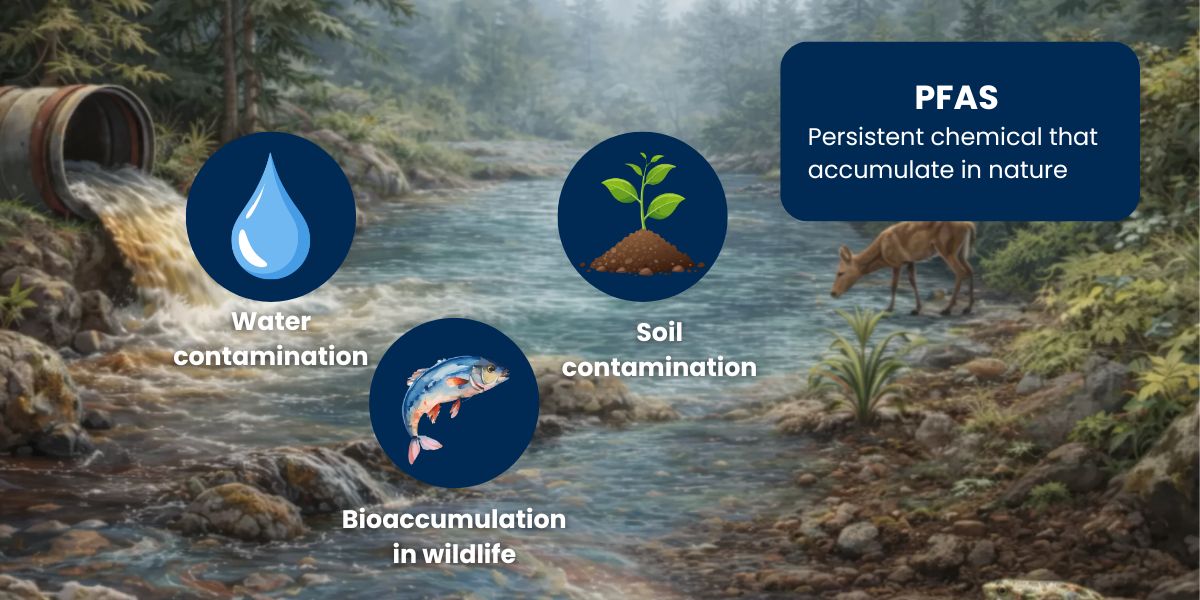
PFAS explained briefly
PFAS stands for per- and polyfluoroalkyl substances.
It is not a single substance, but a broad group of chemicals that includes thousands of compounds.
They have been used for a long time in various applications due to their durability and unique properties.
What these compounds have in common is that they degrade extremely slowly and can accumulate in the environment.
Why is PFAS topical now?
PFAS compounds’ environmental impacts have come under broader scrutiny in recent years.
As a result, wide-ranging restrictions on their use are being prepared in the EU.
Not all details are final yet, but the direction is clear: requirements are tightening.
How is PFAS related to refrigerants?
The PFAS discussion is linked to refrigerants especially through fluorinated compounds.
Many current solutions — whether refrigerants or related materials — are based on fluorine chemistry.
Therefore, PFAS regulation may affect which solutions can be used in the future.
However, not all refrigerants belong to the PFAS group, and the impacts vary depending on the application.
What is REACH?
REACH is an EU chemicals regulation that governs the use and safety of chemicals in Europe.
Restrictions related to PFAS compounds are being prepared as part of this regulation.
In practice, this means that the use of certain substances may be restricted or banned in the future.
What does this mean in practice?
PFAS is not a single substance, but a group.
Therefore, the impacts vary depending on the situation.
In practice, this means:
- not all current solutions are necessarily long-term
- material choices play a greater role
- decisions should not be made based only on current requirements
Is a PFAS-free solution always the right choice?
Not always.
PFAS-free solutions reduce future regulatory risk, but they are not always a technically viable option for all applications.
Refrigerant and material choices are always made based on the overall picture:
- application
- technical requirements
- market
- lifecycle
How should you approach this?
A good starting point is simple:
- identify where PFAS may affect your solution
- evaluate alternatives early
- avoid solutions that may need to be changed mid-lifecycle
The earlier this is done, the more options are available.
Lumikko – a partner from evaluation to implementation
We help our customers:
- identify the impacts of regulation
- compare alternatives
- choose the right solution
- implement it in practice
It’s not about a single choice, but the overall whole.
Would you like to see how this relates more broadly to refrigeration solutions?