
How do defense vehicle HVAC systems perform in extreme conditions?
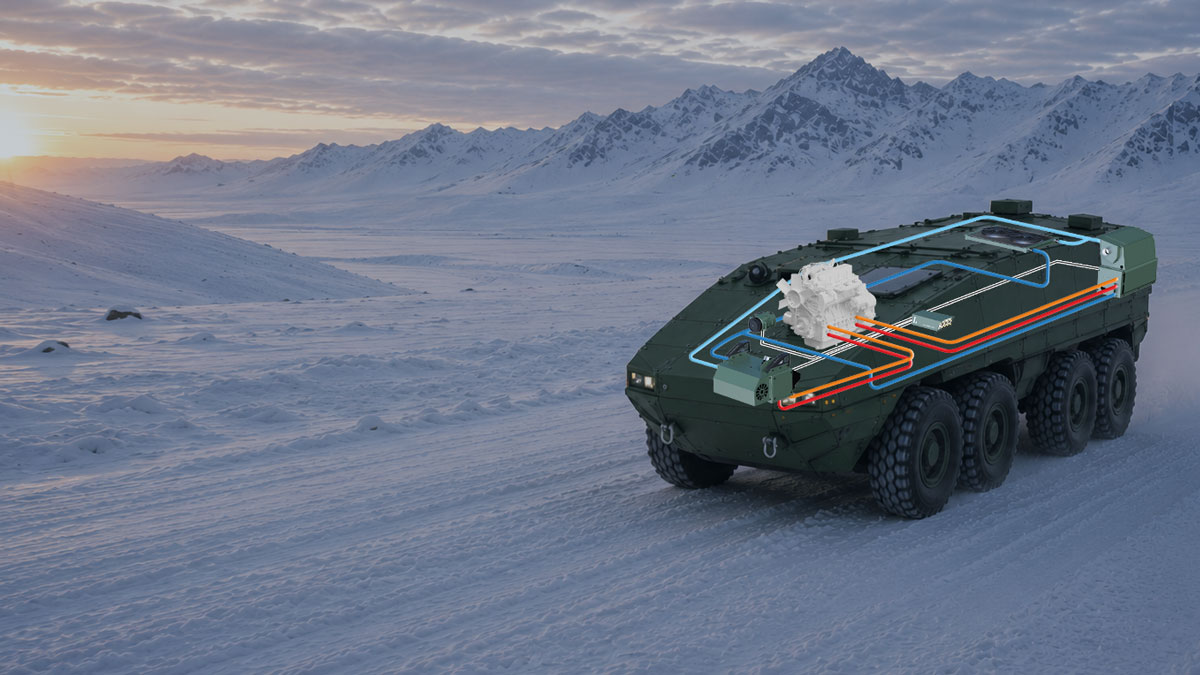
Military vehicle HVAC systems must provide heating, cooling and ventilation in demanding environments, from Arctic cold to desert heat. Their performance depends on how well the system is designed for the vehicle’s operating conditions, thermal loads and installation requirements.
Extreme temperatures are only part of the challenge. Defence vehicles may also expose HVAC equipment to vibration, mechanical shock, dust, humidity and limited maintenance opportunities.
Unlike conventional vehicle climate control, defence HVAC systems are often subject to platform-specific environmental, mechanical and electrical requirements. Reliable performance therefore requires appropriate system design, component selection, integration and testing.
How do extreme temperatures affect military vehicle HVAC performance?
The performance of a military vehicle HVAC system depends on both the external environment and the heat loads inside the vehicle.
An HVAC system may need to operate in very low or high ambient temperatures, but its available heating and cooling capacity can vary across that range.
The specified operating temperature range should therefore not be confused with a guarantee of identical performance under all conditions.
Heating performance in Arctic conditions
In extremely cold conditions, a military vehicle HVAC system must provide sufficient heating despite heat losses through the vehicle structure and the thermal mass of cold interior components.
Heating may be provided through engine coolant, electric heating elements or independent heating equipment, depending on the vehicle architecture.
Key considerations include:
- Heating capacity at the specified ambient temperature
- Warm-up time after a prolonged period in cold conditions
- Available heating energy and electrical power
- Suitable component and material selection for low-temperature operation
- Air distribution and window demisting requirements
Cold-weather performance must be evaluated according to the vehicle’s actual operating requirements rather than relying on a single minimum temperature rating.
Cooling performance in desert conditions
High ambient temperatures create different challenges for military vehicle air conditioning systems.
As outside temperatures rise, rejecting heat through the condenser becomes more demanding. This can reduce refrigeration efficiency and, depending on the system, its available cooling capacity.
Solar radiation, crew occupancy, onboard electronics and heat transferred through the vehicle structure can further increase the cooling load.
Effective high-temperature performance therefore depends on appropriate cooling capacity, condenser sizing, airflow management and system controls.
The objective is to provide the required cooling performance under defined operating conditions while protecting the equipment from excessive thermal and electrical loads.
How do vibration and mechanical shock affect defence vehicle HVAC systems?
Military vehicles may operate on uneven terrain where repeated vibration and mechanical shocks place additional stress on installed equipment.
These loads can affect mounting structures, electrical connections, refrigerant piping and other mechanical components.
To address these challenges, HVAC systems can incorporate appropriate mounting arrangements, mechanical support, suitable components and installation methods designed for the expected operating environment.
The required vibration and shock resistance depends on the vehicle platform and the location of the installed equipment.
Relevant testing helps verify that the HVAC system can withstand the mechanical loads specified for the application.
How do dust, humidity and harsh environments affect HVAC reliability?
Environmental contamination can affect the operation and service requirements of military vehicle HVAC systems.
Dust and sand: Airborne particles can obstruct air filters and heat exchangers, restricting airflow and reducing cooling performance. Appropriate protection and maintenance access are important considerations.
Humidity and condensation: Moisture can affect electrical components and create condensation risks. System design must account for moisture management, drainage and protection of sensitive components.
Corrosive environments: Exposure to moisture, salt and other corrosive substances may require suitable material selection, protective coatings and component protection.
The necessary protective measures depend on the vehicle’s deployment environment and defined operating requirements.
How are military vehicle HVAC systems tested for extreme conditions?
Reliable performance begins with clearly defined technical and environmental requirements.
Depending on the vehicle programme, HVAC equipment may be evaluated through climatic, mechanical and electrical testing.
Relevant standards can include MIL-STD-810 for environmental engineering considerations and laboratory testing, NATO AECTP-230 for climatic conditions and MIL-STD-461 for electromagnetic interference requirements.
The applicable standards, test methods and acceptance criteria must be determined for each application.
Testing individual components is important, but the integration of the HVAC system into the vehicle must also be considered. Available electrical power, airflow, installation geometry and the vehicle’s total thermal load can all influence final system performance.
A system’s compliance with specified requirements should be supported by appropriate verification and documentation.
How does CBRN filtration affect HVAC design in demanding conditions?
Some defence vehicles require specialised collective protection against chemical, biological, radiological and nuclear (CBRN) threats.
In these applications, filtration, ventilation, pressure management and vehicle sealing must be considered together.
Environmental conditions can influence air-management requirements, making correct system integration particularly important.
CBRN protection is a separately specified capability and is not automatically included in every military vehicle HVAC system.
Learn more about Lumikko’s CBRN filtration solutions.
Why is maintainability important in extreme environments?
Military vehicle HVAC systems may remain in service for many years, often in environments where maintenance access is limited.
Long-term reliability depends not only on the initial design but also on appropriate inspection, servicing and spare parts availability.
Accessible components, serviceable layouts and suitable maintenance procedures can help reduce maintenance complexity and support system availability.
Maintenance requirements should be defined according to the equipment and operating conditions. Certain tasks, including refrigerant circuit work, require appropriately qualified personnel and equipment.
Military vehicle HVAC solutions by Lumikko
Lumikko has developed thermal management solutions for demanding defence applications since 1985.
Our modular HVAC systems are designed for wheeled, tracked and special-purpose military vehicles, with system configurations tailored to the platform’s thermal loads, installation constraints and operating environment.
With design, manufacturing and testing capabilities in Seinäjoki, Finland, we support customers in developing and integrating thermal management solutions for demanding applications.
Looking for an HVAC solution for extreme operating conditions?
Explore Lumikko’s military vehicle HVAC systems or contact our team to discuss your vehicle’s environmental requirements, cooling and heating needs, and system integration.