
What are the benefits of advanced HVAC systems for military vehicles?
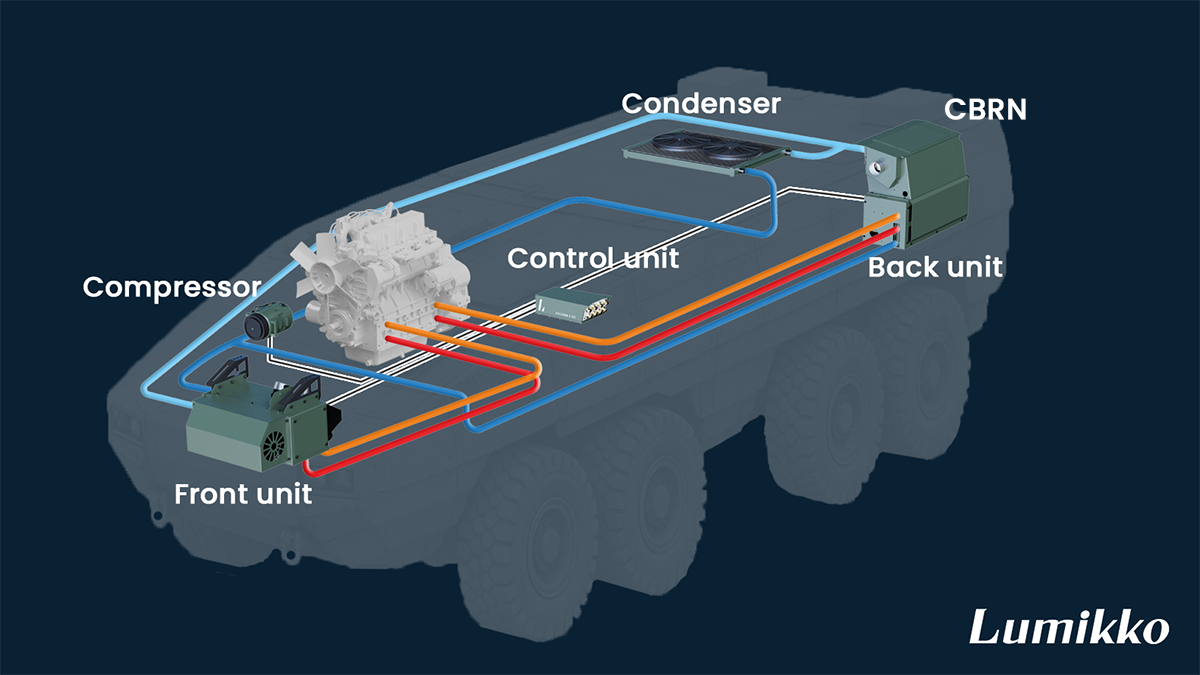
Advanced military vehicle HVAC systems help maintain suitable thermal conditions for crews and onboard equipment in demanding operational environments. Beyond heating and cooling, a well-designed system can offer benefits in system integration, reliability, maintainability and long-term lifecycle support.
For military vehicle manufacturers, the key advantage is not simply greater cooling or heating capacity. It is having a thermal management system designed around the vehicle’s actual operating conditions, available space, power supply and technical requirements.
What are the main benefits of advanced military vehicle HVAC systems?
Purpose-engineered HVAC systems can provide several important benefits:
- Improved crew conditions: Effective heating, cooling and ventilation help reduce exposure to excessive heat and cold.
- Support for temperature-sensitive equipment: Suitable thermal management helps maintain the required operating environment for onboard equipment within the system’s design scope.
- Flexible integration: Modular architectures allow components to be positioned according to vehicle layout and installation constraints.
- Reliability in demanding conditions: Systems can be designed and verified against specified climatic, mechanical and electrical requirements.
- Long-term maintainability: Service accessibility, component availability and lifecycle support can be considered from the beginning of the design process.
The actual benefits depend on the selected system architecture and the vehicle’s operating requirements.
How does military vehicle HVAC support crew performance and safety?
Military crews may spend extended periods inside enclosed vehicles exposed to demanding temperatures, limited ventilation and heat generated by onboard equipment.
Excessive heat can contribute to fatigue, discomfort and reduced physical or cognitive performance. Cold environments can also affect crew comfort and manual dexterity.
An appropriately designed HVAC system helps limit these thermal stresses by providing heating, cooling and controlled air circulation. Ventilation can also support air quality by supplying the required amount of outside air, depending on the vehicle architecture and operating mode.
Maintaining suitable cabin conditions is particularly important during extended operations, when environmental exposure and internal heat loads may place additional demands on the crew.
How can HVAC systems support onboard electronics?
Modern military vehicles carry equipment such as communications systems, navigation electronics, control units and other temperature-sensitive components.
These systems generate heat and may have specific environmental operating limits. Excessive temperatures and moisture can affect performance and reliability.
Depending on the vehicle architecture, thermal management may involve conditioned compartment air, dedicated airflow or separate cooling circuits.
Battery systems and high-power electronics may also require dedicated thermal management. These functions should be considered at vehicle-system level rather than assuming that the crew-compartment HVAC can handle every thermal load.
The benefit of coordinated thermal management is that individual cooling requirements can be addressed as part of the overall vehicle design.
Why is modular HVAC design beneficial for military vehicles?
Military platforms differ significantly in their size, configuration and operational requirements. A compact tactical vehicle and a large armoured personnel carrier may require very different HVAC architectures.
Modular design allows components such as compressors, heat exchangers and control units to be positioned according to available installation space, airflow requirements and service accessibility.
This can help manufacturers integrate heating and cooling without unnecessarily restricting the vehicle’s usable interior space.
Depending on the platform, the appropriate solution may be a compact integrated unit or a distributed system with components installed in different locations.
A modular approach can also provide flexibility when adapting an existing product platform to new vehicle requirements.
Can military HVAC systems integrate with CBRN filtration?
Some military vehicles require collective protection against chemical, biological, radiological and nuclear (CBRN) threats.
Where this capability is specified, specialised filtration and air-management equipment must be coordinated with the vehicle’s HVAC and ventilation architecture.
A collective protection system may combine suitable particulate and gas filtration with controlled airflow and positive pressure in a protected compartment.
The required protection depends on the complete system, including filtration performance, pressure control and vehicle sealing. CBRN protection is therefore a separately specified capability, not an inherent feature of every military HVAC system.
Lumikko develops CBRN filtration systems designed for integration with demanding defence applications.
How does purpose-engineered HVAC improve reliability and maintainability?
Military vehicle HVAC systems can be exposed to demanding operating conditions, including temperature extremes, vibration, shock, dust and limited maintenance opportunities.
Designing a system around the vehicle’s requirements allows these factors to be addressed during component selection, mechanical design and system integration.
Depending on the programme, applicable requirements may include standards such as MIL-STD-810 for environmental engineering and testing, and MIL-STD-461 for electromagnetic compatibility.
The relevant requirements and verification methods must be determined for each application. Compliance with a particular standard should only be claimed when supported by appropriate testing and documentation.
Reliability also depends on maintenance considerations. Accessible components, serviceable designs and long-term spare parts support can help reduce maintenance complexity and support vehicle availability throughout its lifecycle.
Should defence OEMs choose standard or customised HVAC systems?
The right solution depends on the vehicle’s requirements.
An existing HVAC product may be suitable when its performance and interfaces already meet the application needs. In other cases, an established product platform can be adapted to fit specific installation, electrical or control requirements.
Fully customised solutions may be needed when vehicle architecture, performance requirements or environmental conditions cannot be addressed effectively through an existing design.
Considering these alternatives early in the development process helps identify an appropriate balance between integration effort, technical performance, project cost and long-term support.
Military vehicle HVAC solutions by Lumikko
Lumikko has developed thermal management solutions for demanding defence applications since 1985.
Our solutions range from established HVAC products to adaptable and fully customised systems for wheeled, tracked and special-purpose military vehicles.
With design, manufacturing and testing capabilities in Seinäjoki, Finland, we support customers in developing HVAC solutions tailored to their vehicle requirements and operating conditions.
Looking for a reliable HVAC solution for your military vehicle?
Explore Lumikko’s military vehicle HVAC systems or contact our team to discuss your platform’s heating, cooling, integration and lifecycle requirements.