
Mobile Machinery and Thermal Management: What Challenges Does the Design Involve?

The electrification of mobile machinery is fundamentally transforming the role of thermal management. It is no longer about a single cooling unit, but about a system-level solution that directly impacts machine performance, safety, and lifecycle.
In addition to battery size and power, the thermal management solution plays a defining role in the overall performance of an electric machine.
Battery temperature directly affects:
- Available power
- Charging speed
- Charging speed
- Safety
Yet in many projects, thermal management is only considered once the available space has already been largely allocated.
In this article, we explore five key challenges that differentiate thermal management in mobile machinery from conventional cooling solutions.
1. Refrigerant Choices Redefine the Design Foundation
The tightening EU F-gas Regulation and the expanding PFAS restrictions under REACH are permanently reshaping the refrigerant landscape. HFC and HFO solutions are no longer viable long-term strategies.
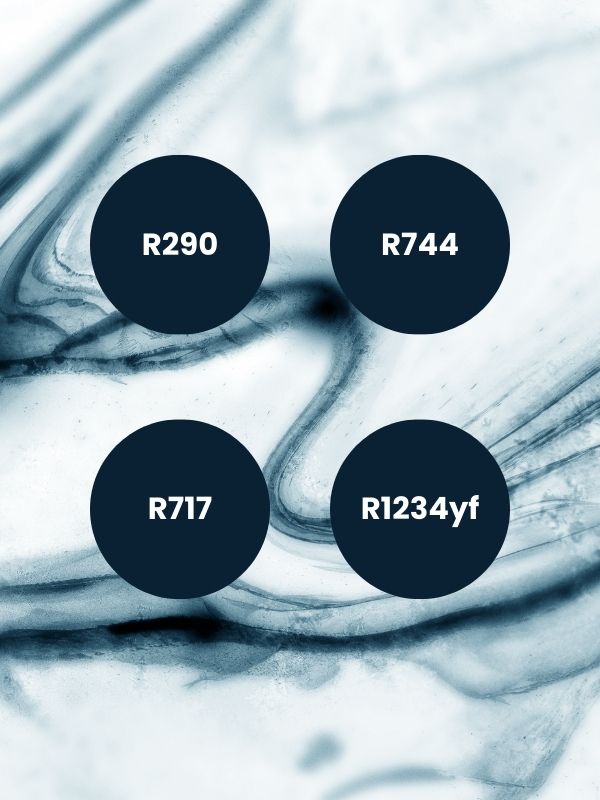
Natural refrigerants such as propane (R290), carbon dioxide (R744), and ammonia (R717) are becoming increasingly central — including in battery thermal management for mobile machinery. In addition, R1234yf (tetrafluoropropene) has a low GWP value, similar to natural refrigerants.
However, each comes with specific design implications:
- CO₂ (R744) involves high operating pressures and requires structural dimensioning accordingly.
- Propane (R290) demands fire safety considerations already at the layout design stage.
- Ammonia (R717) requires industrial-grade leak detection and safety systems.
- R2134yf’s use is limited by interpretations of the upcoming PFAS restriction.
Refrigerant selection affects the entire machine architecture — not just the cooling unit. For this reason, thermal management must be integrated into overall machine design from the beginning, not treated as a standalone component.
2. Placement and Space Constraints
Space inside mobile machinery is limited and weight matters.
From a thermal management perspective, the following must be considered:
- Battery capacity
- Structural constraints
- Serviceability
- Airflow
- Load and charging cycles
- Ambient temperature
- Target battery temperature range
Too often, the cooling system is forced into an already finalized machine layout. This can result in compromises in airflow, serviceability, and performance.
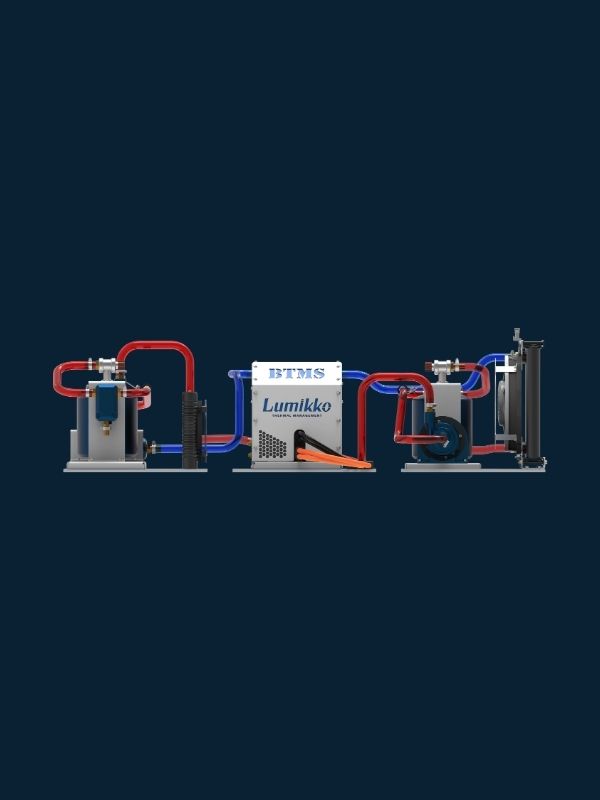
A distributed architecture is often an effective solution. Components such as compressors, heat exchangers, pumps, and control units are positioned throughout the machine. This approach:
- Optimizes space utilization
- Eliminates the need to charge the refrigerant circuit during machine assembly.
- Enables customer-specific design.
- Improves weight distribution
- Enhances protection against impacts and dust
- Simplifies maintenance
Beyond cooling capacity dimensioning, mechanical and spatial compatibility play a crucial role in thermal management success.
3. Operating Voltages and Heat Generation
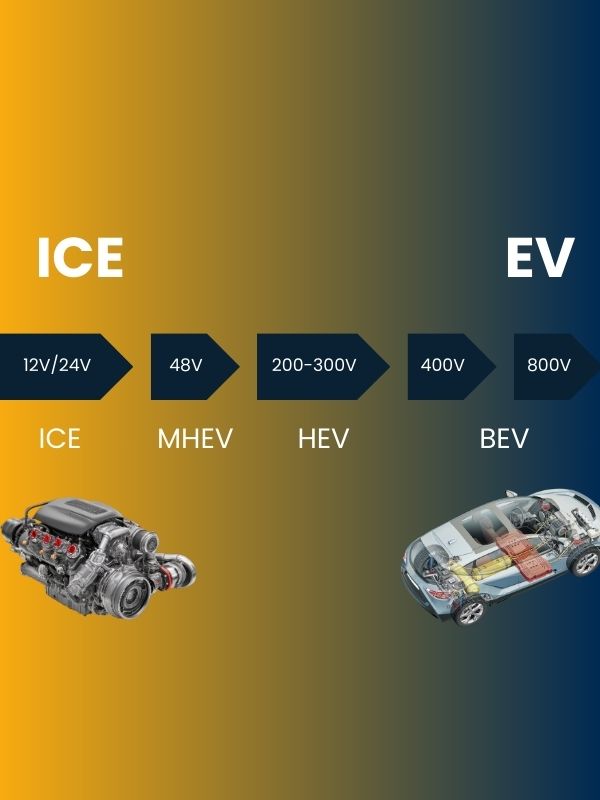
The transition from internal combustion engines to fully electric machinery also increases operating voltage levels. Where conventional vehicles operated at 12V or 24V, fully electric machines now operate at 400–900 VDC.
Heat must be managed across multiple systems:
- Battery
- Power Electronics
- Electric motor
- Fast charging system
- Cabin
In high-voltage systems, the challenge is often “a large amount of heat in a short time,” whereas in low-voltage systems it was more about “continuous excess heat.”
4. Managing Thermal Loads Throughout the Product Lifecycle
As batteries age:
- Heat generation increases
- Tolerance to high temperatures decreases
- Response to charging loads changes
- Capacity declines
- Charging capability and speed decrease
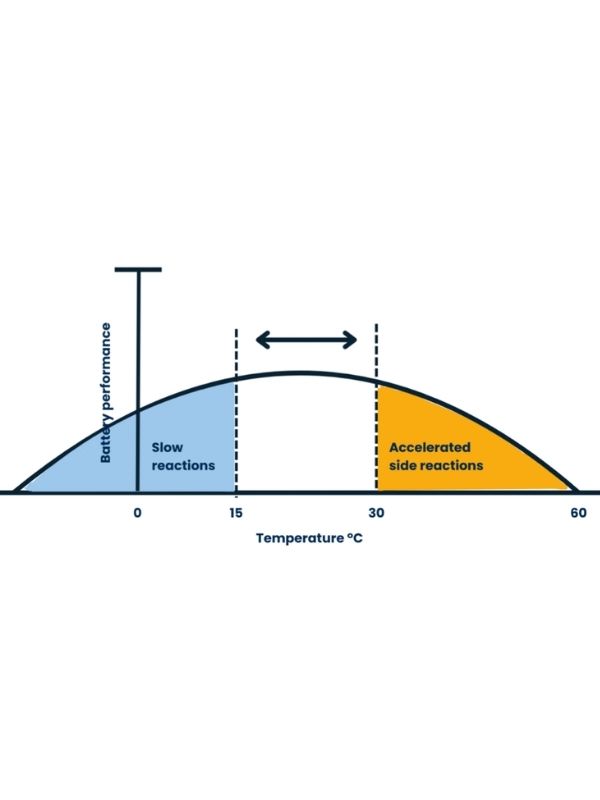
Battery cooling requirements evolve over time. If thermal management is designed solely for a new battery, the system may be undersized within a few years.
Design must therefore account for:
- Capacity margins — cooling must be dimensioned for aged battery performance
- Adaptive control systems
- Changes in usage patterns
- Correct dimensioning of the refrigeration system and avoiding oversizing are essential. Peak loads can be managed through system design features other than simply increasing nominal capacity.
Lifecycle thinking is an essential part of responsible machine design.
5. Environmental Conditions
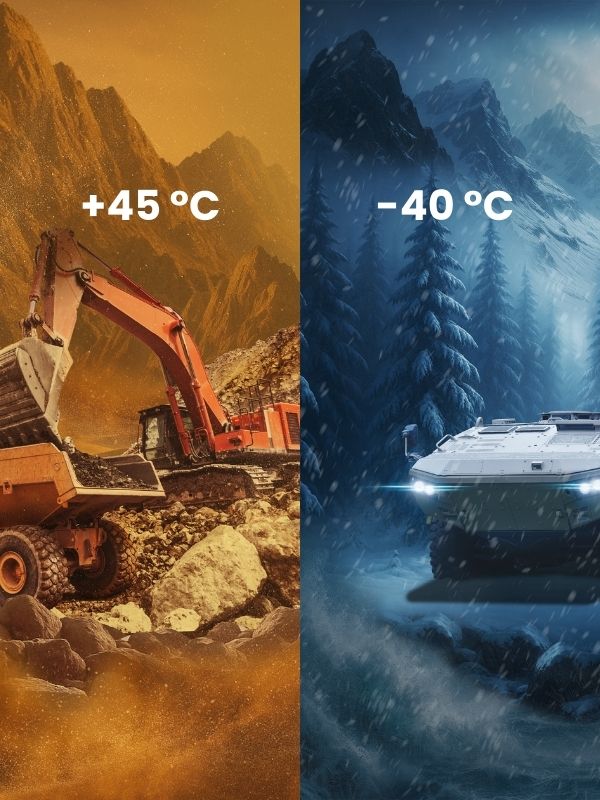
Mobile machinery operates in demanding environments:
- +45 °C summer heat
- -40 °C winter conditions
- Dusty mining environments
- Saltwater exposure in ports
- Continuous vibration and mechanical stress
- Humid conditions
Thermal management systems must withstand:
- Corrosion
- Mechanical impacts
- Dust and contamination
- Large temperature fluctuations
- Continuous vibration
Environmental durability is a fundamental starting point in thermal management system design.
Thermal Management as a Performance Enabler
In electric mobile machinery, thermal management directly impacts:
- Machine uptime and lifetime
- Charging speed
- Energy Consumption
- Safety
- Total cost of ownership
When properly designed, thermal management enables higher performance and a longer service life.
Read More on the Topic:
- Thermal Management in Off-Highway EVs – Why it Matters
- Cooling Solution for a Battery-Powered Mining Machine – Sandvik Case
- Lumikko BTMS: A New Era in Battery Thermal Management
- Natural Refrigerants in Lumikko’s Development Work
Discuss With Our Expert

Mika Sorri
Head of Electrification
+358 40 685 3657
mika.sorri@lumikko.fi
Book a Meeting
Connect on Linkedin